Blakely Wright combines history and anthropology to better understand the past
Sept. 22, 2026
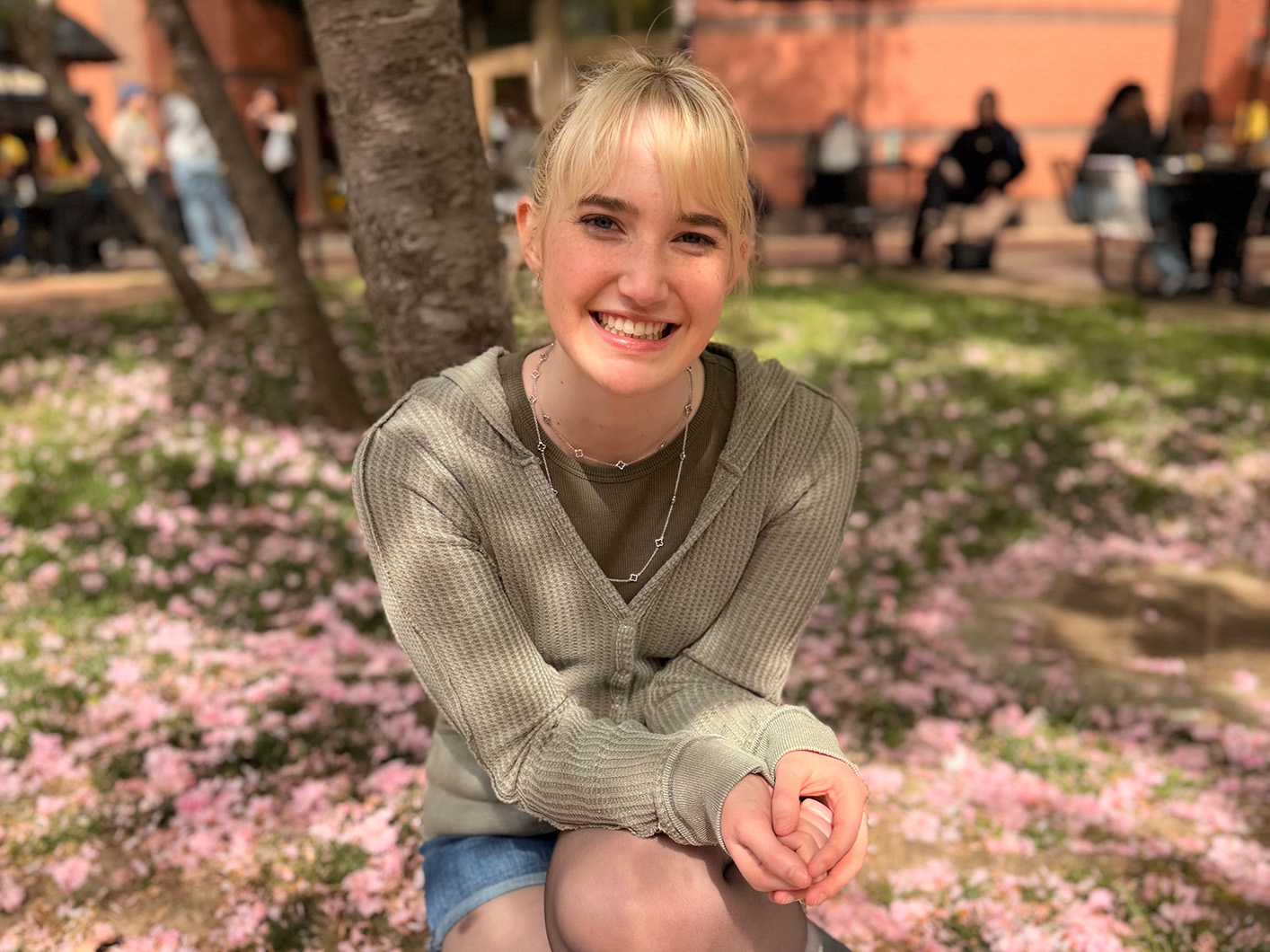
Blakely Wright’s decision to study the past stems from her own family history. The granddaughter of history majors and teachers, Wright loved exploring her grandparents’ home, filled with books, artifacts, and much more. By combining a history major with an anthropology minor she is able to focus on historical events alongside the people and cultures who influenced those events.
To enhance her anthropological knowledge, she recently completed an internship with the Virtual Curation Laboratory and can still be found there when she’s not in class, working on illustrations of prehistoric animals and anthropological sites.
Wright’s path forward also takes inspiration from her familial roots. As she looks to her future, she plans to apply for graduate school to pursue opportunities in education, public history, or anthropology. She also hopes to find volunteer and work opportunities in museum archives or in teaching.
Why did you choose to major in history and minor in anthropology?
I am majoring in history to honor my grandparents who were both history majors as well as teachers, and I want to follow in their footsteps. I am passionate about how our complex past experiences have led us to today. I specialize in American history with a focus on African American and Indigenous cultures.
Initially I was an anthropology major before switching it to my minor. My interests in anthropology began long before I even knew the definition. I used to love looking at fossils of our prehistoric ancestors as well as researching different cultures in middle school. I always knew that I had loved learning about history, but I never knew what anthropology exactly was prior to college.
It was during my time at community college that I discovered the field and took an introductory class. It kind of clicked for me then why I loved learning about different perspectives, as they teach us new things we may have never thought of before.
Can you tell me more about what it means to you to follow in your grandparents’ footsteps as a history major?
It means everything to me. From as far back as I can remember my maternal grandparents were a major part of my upbringing. They always encouraged and assisted with my education, from the moment I was born until the day they passed.
My grandmother was a middle school history teacher and my grandfather was a history professor at Jacksonville State University briefly before changing careers. My grandfather, who fought in the Korean War, was always willing to teach me and he was the first primary source I had ever interviewed. I miss my grandparents and wish I could tell them how much I have learned.
What drew you to specialize in American history with a focus on African American and Indigenous cultures? How do these studies pair with your anthropology studies?
I was drawn to these areas because I wanted to center history around human experiences that have often been marginalized in traditional narratives. It was a great honor to focus my final paper in HIST 300: Introduction to Historical Study on the enslaved people at Rosewell Plantation, where interviewing Fairfield Foundation archaeologists Dr. David Brown and Thane Harpole provided critical primary records for my research.
Pairing this with my anthropology minor has been extremely valuable especially when studying Indigenous cultures, as well. I view every day as a learning opportunity, and there is still so much I am eager to explore in American history.
How has combining history and anthropology studies enhanced your academic experience?
I believe that history and anthropology truly go hand-in-hand. Through cultural and linguistic ethnography, I can bridge gaps in the historical record and bring broader context to primary and secondary sources. Ultimately, anthropology enriches my study of history by helping me deeply empathize with and understand the human experience behind the timeline. Carrying skills from both disciplines into my work makes each field all the more rewarding.
What have been your favorite classes so far?
My favorite class I have taken for my major so far has been HIST 300: Introduction to Historical Study with Brooke Newman, Ph.D. I am also enjoying HIST 408: Studies in Modern American History with Brian Daugherity, Ph.D. My favorite aspect of both of these classes have been the discussion-based setting. I really enjoyed meeting my classmates in Dr. Newman's class, many of whom I am now studying alongside with Dr. Daugherity. Both professors do a great job at student engagement and collaboration, which really enhances the experience of class when you feel like you're truly learning side by side with your peers. Overall, I really appreciate Dr. Newman and Dr. Daugherity, and I have learned so much about European and American history from their classes.
My favorite elective I have taken so far is ANTH 391: Women in Islam with Samaneh Oladi, Ph.D. I learned so much about the Middle East and the history of its culture as well as religion. Dr. Oladi is a fantastic professor, and I truly enjoyed her classes, as well as the content I was able to study. I feel that I gained a greater appreciation for feminist movements in the United States and abroad, especially concerning Muslim women.
Favorite professor so far?
Bernard Means, Ph.D., is my favorite professor who really sparked my love for archaeology and my wish to be able to share that passion with my peers, as well as those interested in history. When I took his ANTH 105: Introduction to Archaeology class, I learned about his research about the Monongahela culture, an ancient Native American people who lived in present-day Pennsylvania, Ohio, and West Virginia. Researching their burial practices and grave goods (such as pottery, arrowheads, and bone beads) was truly enlightening, inspiring my desire to further study prehistoric Indigenous cultures in North America. There is so much more I hope to learn and research during my time at VCU and afterwards!
Dr. Means also told me of opportunities both at VCU and outside, such as the National Conference on Undergraduate Research, where I ended up presenting an archaeology abstract I worked on in his introduction class.
How have you connected what you've learned in the classroom with your internship work?
I completed an internship at the Virtual Curation Laboratory this summer. The internship allowed me to learn more about historical public outreach at different museums in Virginia, such as the Museum of Science, The Valentine Museum, and the Isle of Wight County Museum.
It also allowed me the opportunity to work with middle school students over the summer, during the College of Humanities and Sciences Summer Camps, which was my favorite moment during the internship. I realized how much I love working with younger students, and I hope to be able to help future generations foster their love of history, anthropology, and science while being able to apply their passions in the real world.
I still enjoy drawing at the Virtual Curation Laboratory in my free time. I have been working on illustrations of prehistoric animals and anthropological sites.
Most interesting thing in your major's curriculum that you've learned or an experience you've had?
The best experience I have had at VCU, as I mentioned previously, was my internship which included working with Amy Rector, Ph.D., during the anthropology-based summer camp session – Print the Past in 3-D: Virginia's Digital Heritage Adventure. It was a true honor, as I realized how much I enjoy teaching archaeology and anthropology to students, and it has made me want to possibly pursue teaching elementary or middle school as a future career goal. Working with younger children who had such a great interest in history as well as 3D-scanning and printing was such a fun experience, and I had a great time.